Studying at ESMT: from preparatory science classes to Master's degrees, choosing your path
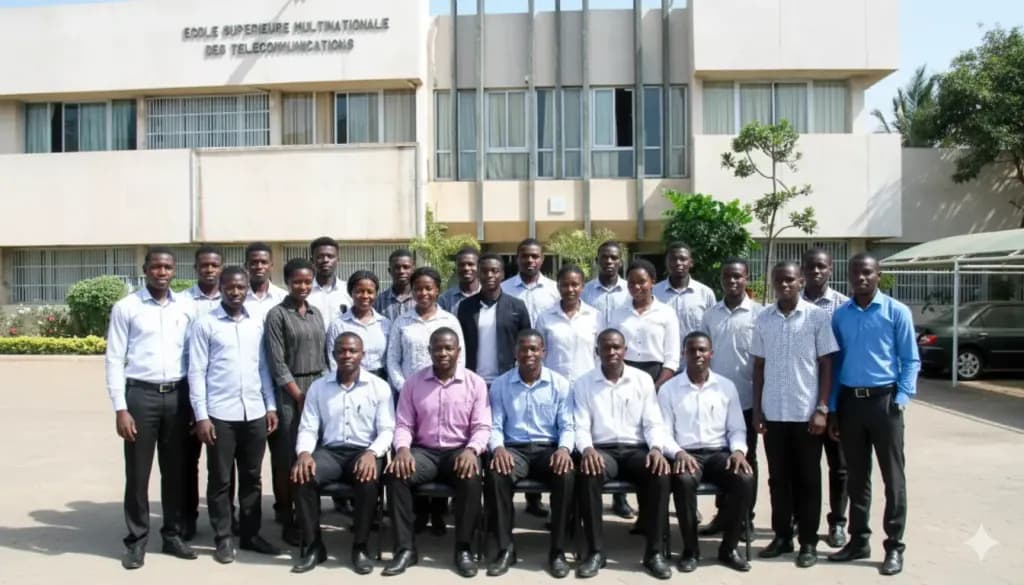
1. A regional school serving STEM talent
A pioneer at the crossroads of telecommunications and digital technology, ESMT is a multinational institution based in Dakar that has spent more than four decades training specialists able to design, deploy and secure ICT infrastructure and services. Its educational mission has a twofold horizon: meeting the immediate needs of employers (operators, equipment manufacturers, IT services firms, regulators, fintechs, government bodies) and anticipating the skills of tomorrow in critical fields such as cybersecurity, broadband networks, the IoT, 5G/6G, cloud, data and AI. Because uses and technologies move fast, the school builds its programmes around progressive learning blocks (applied mathematics, electronics, systems, networks, programming, data, technical management) and around projects that confront students with real-world cases (sizing a fibre backbone, radio planning, cloud integration, security auditing). The teaching model combines academic lectures, laboratory practicals, tutorials, tool-based workshops and internships, with a central place given to certifications and to international openness (partnerships, seminars, industry speakers). This continuum approach — from preparatory science classes through to Master's degrees — allows a wide variety of profiles (science school-leavers, holders of two- or three-year higher qualifications, engineers in the making, professionals retraining) to find an entry point and a coherent trajectory. When choosing a path, the essential thing is to align your strengths (mathematics, physics, coding, networks, project management) with a precise career plan: students drawn to fieldwork will favour streams with a strong practical component (networks, fibre, monitoring), while an “information systems/data” profile will opt for IS urbanisation, software architecture and analytics. ESMT supports that thinking with modules on guidance, soft skills (communication, leadership, collaborative working) and entrepreneurship, so that technical know-how is anchored in solving real problems.
2. Preparatory classes then Bachelor's degrees: embedding the fundamentals and sharpening a telecoms/digital profile
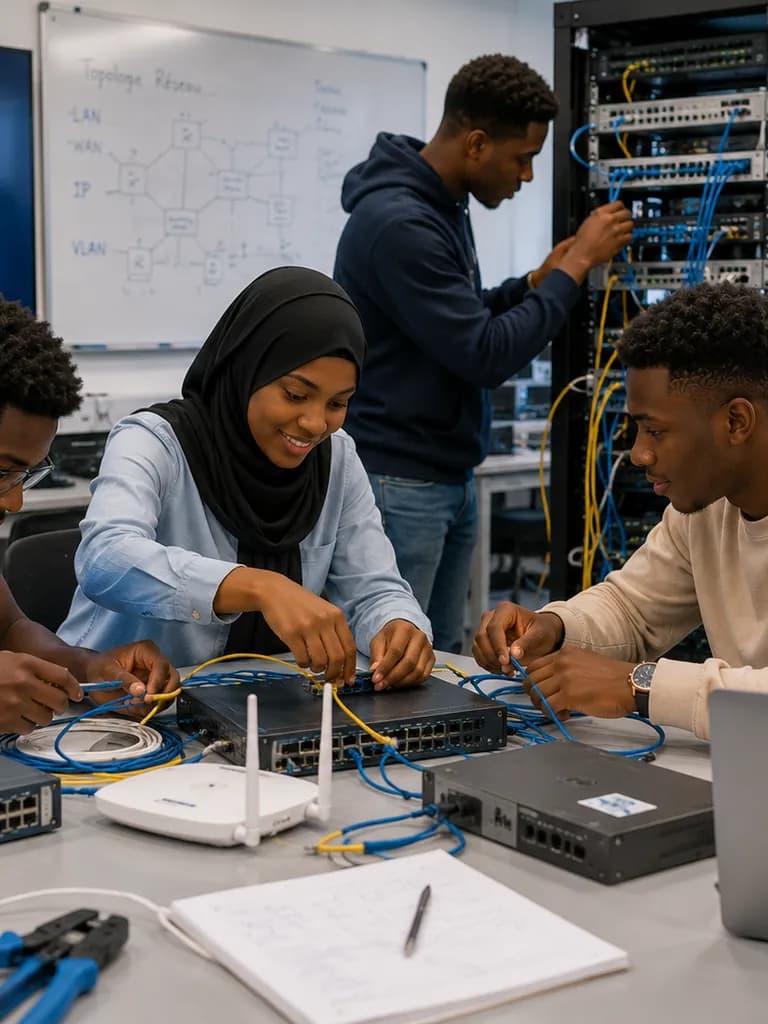
The Preparatory Science Classes (CPS) act as a springboard to success: they go deep into linear algebra, calculus, physics (mechanics/electricity), digital logic and structured programming, while building the methodical rigour (problem solving, written work, critical thinking) that is indispensable later on. Assessment alternates between continuous assessment, supervised tests and short projects; the aim is not to cram but to make sound reasoning second nature. By the end of the CPS, students have a robust foundation on which to move up to the longer programmes. The vocational Bachelor's degrees consolidate those foundations and are organised around skills blocks: systems (Linux administration, virtualisation, Bash/Python scripting), networks (addressing, routing, VLANs, QoS, L2/L3 security), development (OOP, APIs, relational and NoSQL databases), web (front and back end), cybersecurity (hardening, basic cryptography, application security), electronics and sensors (boards, buses, interfaces). Supervised projects force students to combine these building blocks: deploying a segmented and monitored LAN/WAN, building a secure web app backed by a database, integrating an observability pipeline (collection, alerting, dashboards), or prototyping an IoT sensor network for agriculture. Added to this are professional communication, project management (WBS, risks, indicators), technical English and preparation for certifications (ITIL, Linux/Network+). The Bachelor's degree then becomes a passport to employment (systems/network technician, level 2/3 support, junior administrator, junior full-stack developer) or to further study in engineering, depending on appetite and performance.
3. Engineering degree: designing and steering complex systems
ESMT's Engineering programme raises students to the level of “architect” and “integrator”. It explores protocol layers in depth (from physical to transport), traffic engineering, radio planning, quality of service, security by design, automation (SDN/NFV), microservices architecture and data engineering. Workshops place the emphasis on modelling and simulation (sizing a 4G/5G network or an IP/MPLS backbone), observability (telemetry, SIEM), compliance (security policies, auditing), interoperability and change management. Technical management (CAPEX/OPEX budgets, contracts, SLAs), digital law and the economics of innovation equip future engineers to deal with IT departments, executive management, regulators and partners. The final-year project (PFE) acts as the pivot of excellence: it requires students to bring together architecture, implementation, testing, a security dossier and a business case, often in a real setting at an operator, an integrator, a fintech or a government body. Typical final-year topics include migrating infrastructure to a hybrid cloud, securing an information system (segmentation, IAM, SOC), rolling out FTTH, modernising an IP core and setting up a data/BI platform. On graduating, students take on roles as network and security engineers, rollout project managers, IS/data engineers, cloud architects, cybersecurity analysts or consultants. Prospects over three to five years include team coordination, security governance, enterprise architecture and consultancy.
4. Master's degrees and continuing education: expertise, certifications and greater responsibility
ESMT's professional Master's degrees target growth in expertise and responsibility: information systems engineering, IS security, digital transformation management, telecommunications and multimedia, data and digital services. Teaching favours real cases: audits (maturity, risk, compliance), IS urbanisation (application mapping, reference frameworks), distributed architectures, cloud orchestration (infrastructure as code, CI/CD), data governance (quality, cataloguing, protection), UX and service design, and project portfolio management. A dissertation or applied project puts students in the position of building a complete decision-making case (business stakes, solution, milestones, budget, ROI, risks, change management). Alongside this, the continuing education offer provides targeted modules: optical fibre (design, cable pulling, measurement, acceptance testing), project management (fundamentals through to PMP), ITIL, security (policies, controlled penetration testing, incident response), digital transformation (process mining, paperless working), data and analytics (dashboards, storytelling). For working professionals, these certifying courses accelerate careers and mobility; for students, they offer tangible badges and projects to carry into a portfolio (architecture diagrams, scripts, dashboards, audit reports). Combining a Master's degree with certifications optimises employability for roles such as security manager, IS architect, transformation project manager, consultant or technical product owner.