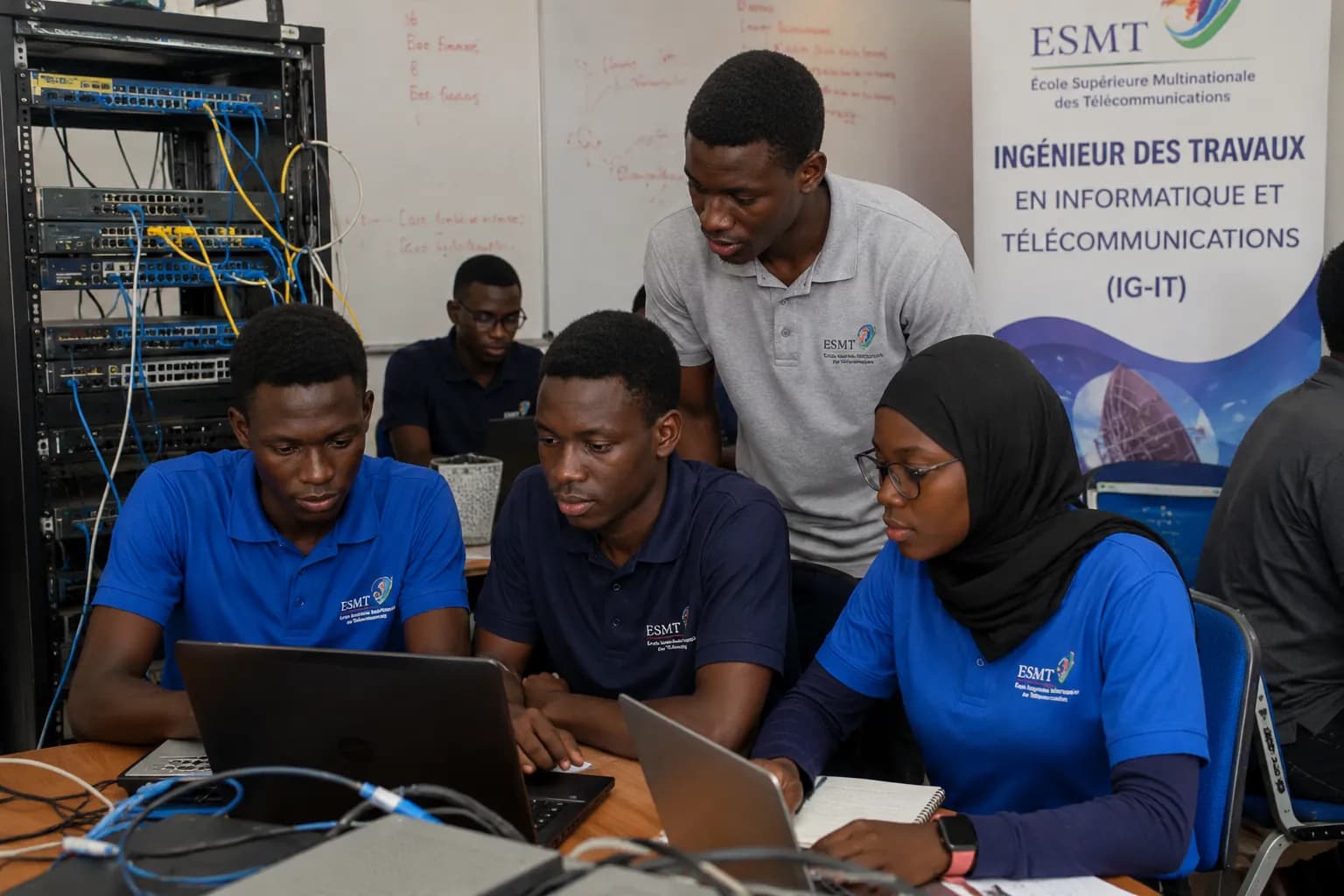
Applied Engineering Programme in Computing and Telecommunications (IG-IT)
A 2-year (4-semester) career-focused programme, compliant with the LMD system, training versatile engineers able to meet the needs of telecommunications and information technology: from network and systems fundamentals through to service platforms and application development, with an internship every year and a dissertation.
- Duration
- 2 years (4 semesters)
- ECTS credits
- 120 Credits
- Format
- On campus
Overview
About this programme
A 2-year (4-semester) career-focused programme, compliant with the LMD system, training versatile engineers able to meet the needs of telecommunications and information technology: from network and systems fundamentals through to service platforms and application development, with an internship every year and a dissertation.
Objectives
The aim of the IG-IT programme is to train, in two years, engineers able to:
- Design, deploy and administer telecoms and IT infrastructures;
- Contribute to the development and operation of digital networks and services;
- Provide support, supervision and optimisation for technology platforms;
- Work on innovative ICT projects;
- Respond effectively to business needs in the fields of telecommunications and computing;
- Thrive in constantly changing technological environments.
The programme also aims to develop:
- Professional autonomy;
- Analytical and problem-solving skills;
- Technical project management;
- A spirit of innovation and collaboration.
Join the class
Admission requirements
Prerequisites
The IG-IT programme is open to applicants holding:
- A DUT;
- A BTS;
- A DTS;
- Or any qualification recognised as equivalent in:
- Computing;
- Telecommunications;
- Engineering sciences;
- or related fields.
Admission is also open:
- To students who have completed two years of Scientific Preparatory Classes
- To holders of a second-year university qualification (L2) in Computing, Telecommunications or Engineering Sciences.
Procedures and requirements
Applicants are selected in two stages: Application review The panel considers in particular:
- Academic degrees and qualifications;
- The syllabus of the applicant's initial training;
- The results obtained;
- As well as any professional experience.
Motivation interview Shortlisted applicants attend an interview covering:
- their academic background;
- Their motivations;
- Their career plans;
- As well as their interest in ICT and telecommunications careers.
Documents required Applicants must submit a file containing:
- A photocopy of their identity document;
- Two (02) passport photographs;
- Academic transcripts for the last two years
- An application fee of 10,000 F CFA
Learning outcomes
Skills covered
- Telecom network architectures, digital transmission and transmission media.
- Systems administration and network services (fundamentals, certifying core technologies).
- 3G/4G mobile networks, traffic management & QoS.
- Programming (C, Java/C++ OOP), algorithms, web development, databases, UML.
- NGN & IMS, client/server architecture, network services, MPLS, SDN/NFV, multimedia platforms.
- Satellite & VSAT, xDSL/FTTx/xPON.
- Cloud Foundations (certifying), virtualisation (servers/networks).
- Application security, mobile application engineering (depending on the DAS specialisation).
- Project management, entrepreneurship, communication, English.
After the programme
Career prospects
- 01Support / operations engineer.
- 02Network / rollout engineer.
- 03QoS and network performance analysis engineer.
- 04Design and studies engineer.
- 05Services development engineer (DAS track).
- 06Consulting engineer / Project manager.
See also
Resources & frequently asked questions
Frequently asked questions
IGIT-RPS (Networks & Service Platforms) or IGIT-DAS (Application & Service Development), from semester 3 onwards.
Go further
Other programmes
 Initial training
Design Engineering Programme (INGC)
- 3 years
- On campus
- Initial training
- 180 Credits
 Evening courses
Master's Degree in Telecommunications and Multimedia (M-TM)
- 2 years
- On campus
- Initial training
- 120 Credits
 Online courses
Master's Degree in Information Technology for Health (M-TIS)
- Online
- Initial training